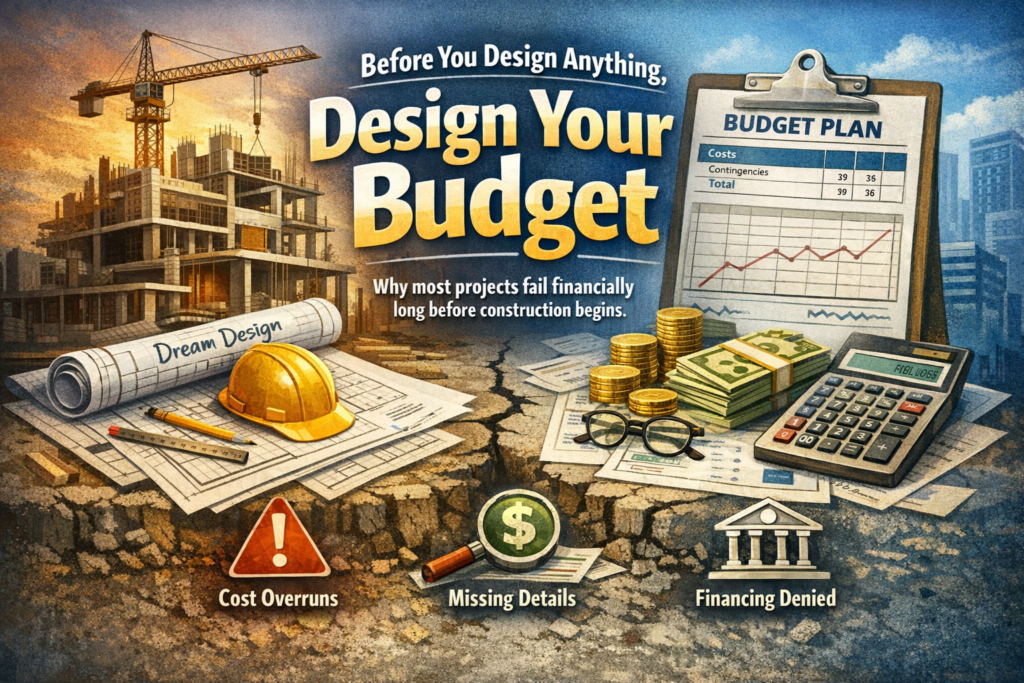
Before You Design Anything, Design Your Budget
Why most projects fail financially long before construction begins
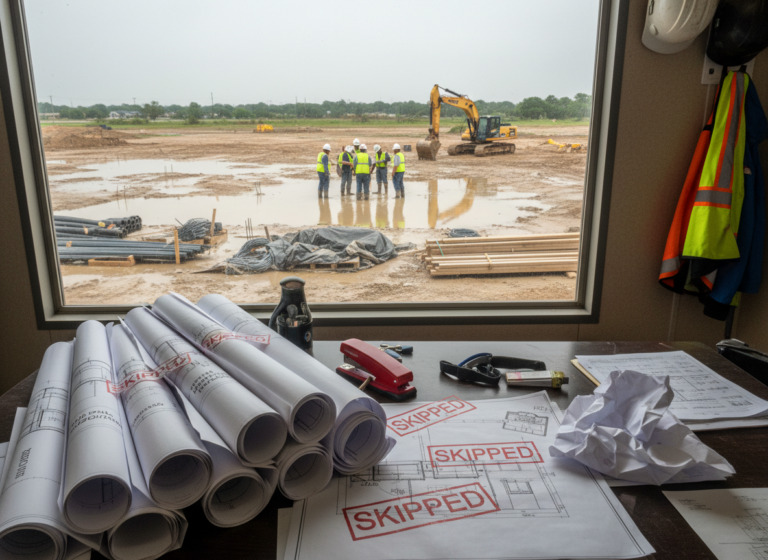
“We’ll Figure the Budget Out as We Go”
That sentence sounds flexible.
It feels optimistic.
And it quietly kills more projects than bad construction ever will.
Most projects don’t fail because they’re poorly built.
They fail because the budget was never designed to support the decisions being made.
A number without logic isn’t a budget.
It’s a guess.
The Core Financial Mistake
Many owners believe design comes first and budgeting follows.
In reality, design and budget must be developed together, or neither one is reliable.
When budget is treated as an afterthought:
- Design decisions are made blindly
- Costs drift instead of converge
- Financing confidence erodes
By the time numbers become “real,” options are already gone.
Why Rough Budgets Create False Confidence
Early “ballpark” numbers often sound responsible:
“We just need a rough idea.”
The problem is that rough budgets:
- Ignore site constraints
- Miss code-driven requirements
- Underestimate structural complexity
- Exclude soft costs and contingencies
They create comfort without accuracy—and confidence without control.
What Lenders and Investors Actually Care About
Banks and investors don’t ask:
“Is this design beautiful?”
They ask:
- Is the scope clear?
- Is the project feasible?
- Is the cost logic defensible?
- Are risks identified early?
Design readiness is how lenders measure seriousness.
Projects with structured budgets and early design alignment:
- Secure better financing terms
- Move faster through underwriting
- Trigger fewer last-minute conditions
The Hidden Truth About Cost Lock-In
Industry research shows that 70–80% of total project cost is committed during the design phase—before most owners realize it.
That means:
- Layout decisions
- Structural systems
- Code compliance strategies
- Material selections
All shape cost long before bids are received.
If budget isn’t guiding design, cost is still being locked in—
just without intention.
The Difference Between a Number and a Designed Budget
A Number
- One total dollar figure
- No breakdown
- No logic
- No flexibility
A Designed Budget
- Aligned with scope and program
- Tied to design decisions
- Includes soft costs, contingencies, and escalation
- Evolves as design evolves
One reacts.
The other leads.
What “Designing the Budget” Actually Means
Designing the budget means:
- Establishing cost ranges early
- Assigning dollars to spaces and systems
- Testing “what if” scenarios safely
- Adjusting design before consequences are expensive
It’s not about locking numbers too soon.
It’s about locking logic first.
Why Projects Blow Up Without This Step
When budget isn’t designed early, projects hit these walls:
- Design that exceeds financial capacity
- Late-stage value engineering
- Compromised quality
- Lost momentum
- Deal fatigue
At that point, owners aren’t asking:
“How do we optimize this?”
They’re asking:
“How do we survive this?”
The Mic-Drop Truth
A budget without design logic is just a guess.
How Experienced Clients Approach It Differently
Seasoned developers and institutional clients start with:
- Financial targets
- Return expectations
- Cost-per-square-foot ranges
- Risk tolerance
Then they design within those guardrails, not outside them.
This approach:
- Preserves optionality
- Builds lender confidence
- Prevents emotional decision-making later
Final Takeaway
Design doesn’t make projects expensive.
Undesigned budgets do.
If you don’t decide where money should go early, construction will decide for you—
and it will not ask permission.
Want a Project That Stays Financially Real?
If you want:
- fewer redesigns,
- fewer painful compromises,
- and stronger conversations with lenders and partners,
budget must be treated as a design tool, not an accounting task.